

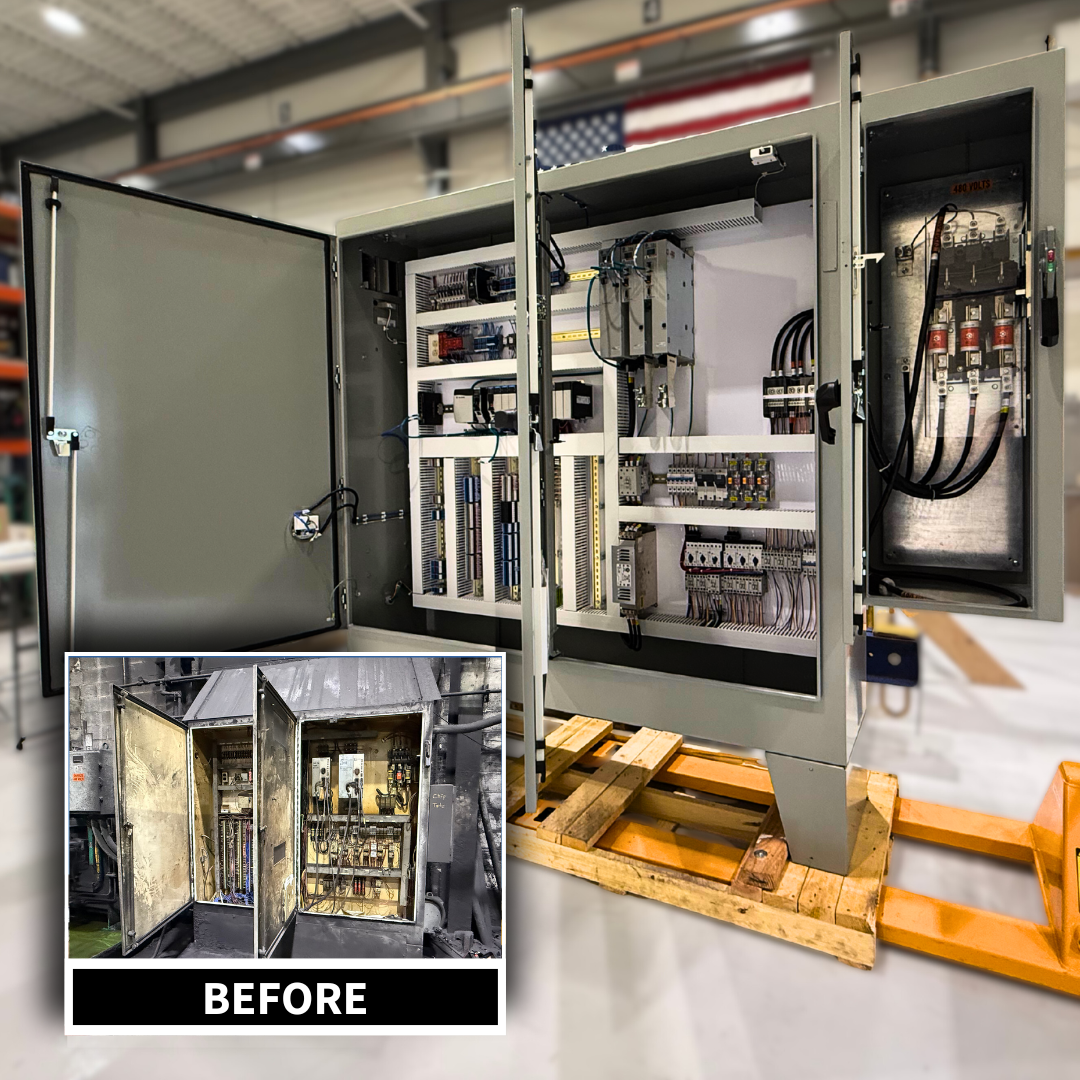
Industrial control panels are the nerve center of your operation—power distribution, logic control, safety, and data all converge here. When panels age out, the risks compound: more downtime, quality drift, cyber exposure, and limited ability to scale or integrate with newer equipment. Many facilities still run panels that are 10–20 years old; those systems were never designed for today’s connectivity, safety, and data requirements.
Below are the most telling signs that your industrial control panel (ICP) has crossed from “serviceable” to obsolete—and why proactive modernization beats waiting for a failure.
Downtime Is Increasing (and Harder to Diagnose)
Recurring or extended outages often point to aging control systems. Obsolete programmable logic controllers (PLCs), outdated wiring, and undocumented modifications make failures both more frequent and harder to diagnose. Plants experience downtime due to reliability issues, lack of compatible spare parts, and fragile system integrations—especially in process‑critical environments.
Planned modernization significantly reduces downtime compared to emergency replacements.
Quality Variability and Process Drift
Aging PLCs, I/O, and sensing stacks often struggle to maintain tight control tolerances. As hardware ages and firmware support ends, process stability suffers—operators see run‑to‑run variation and inconsistent outputs. Modernization projects consistently report improved reliability, tighter control, and easier troubleshooting—reducing variability at the source.
Troubleshooting Takes Too Long
If technicians must trace outdated wiring diagrams or decipher decades‑old ladder logic, your system may be using discontinued PLC platforms or supervisory control and data acquisition (SCADA) software running on unsupported operating systems. Missing project files and undocumented field changes further extend mean time to repair (MTTR).
Spare Parts and Firmware Are Discontinued
Obsolete PLCs, human‑machine interfaces (HMIs), relays, and circuit components often become impossible—or extremely slow—to source. Long lead times or discontinued firmware updates are strong indicators that the panel is at end‑of‑life.
Limited or No Remote Access
Modern operations expect secure remote monitoring and diagnostics. Older ICPs often lack Ethernet connectivity, industrial internet of things (IIoT) compatibility, or secure network pathways. This increases downtime and restricts cross‑team visibility.
Inability to Communicate With Modern Equipment
If your panel cannot support today’s standard communication protocols—such as EtherNet/IP, Profinet, OPC Unified Architecture (OPC UA), or Message Queuing Telemetry Transport (MQTT)—integrating new machines becomes difficult and costly. Compatibility limitations are one of the top triggers for full control system upgrades.
Poor Data Availability for Operations and CI
Industry 4.0 and Industry 5.0 require real‑time data for operational equipment effectiveness (OEE), predictive maintenance, and continuous improvement. Many legacy ICPs cannot collect, store, or transmit meaningful production data. Upgraded panels with IIoT sensors and networked controllers enable high‑value analytics and smarter operations.
No Scalability or Modularity
If small production changes require a full cabinet redesign, your ICP likely lacks modular components or hot‑swappable I/O (input/output) modules. Modern scalable designs support future expansion without major downtime or rewiring—now essential in fast‑changing production environments.
Rising Safety and Cybersecurity Exposure
Older systems may technically “meet code” from the time of installation, but still lack modern safety interlocks, arc‑flash mitigation, and current cybersecurity protections such as network segmentation, encrypted communications, and patch management. Modern upgrades incorporate these safeguards into every layer of the system architecture.
Your Total Cost to Maintain Keeps Climbing
When the cost of troubleshooting, part sourcing, integration workarounds, and unplanned downtime is tallied, running obsolete equipment is often far more expensive than upgrading. This trend is reflected in the market: the global ICP industry is projected to grow from $15.5 billion in 2026 to $21.7 billion in 2033, largely driven by modernization initiatives.
What to Do Next
A structured controls lifecycle assessment, documenting hardware conditions, firmware status, safety compliance gaps, and network‑level risks, helps identify the fastest opportunities for improvement. From there, facilities typically move into phased modernization, including migrations to new PLC and Programmable Automation Controller (PAC) platforms, segmented industrial networks, modular input/output (I/O) architectures, supervisory control and data acquisition (SCADA) upgrades, and industrial internet of things (IIoT) gateways. Partnering with a premier modernization specialist like GES Automation ensures these upgrades are engineered for long‑term reliability, seamless integration, and maximum return on investment, positioning your operation for measurable gains in uptime, performance, and data visibility.
Sources & Further Reading
-
Control system upgrade drivers & benefits (reliability, safety, uptime, parts availability, integration): PolSys—Industrial Control System Upgrades & Retrofits. [polsys.com]
-
Planned modernization vs. emergency replacement; global automation growth context: OSCO Controls—How Upgrading Process Control Panels Drives Manufacturing Competitiveness. [oscocontrols.com]
-
Legacy PLC/SCADA risks, unsupported platforms, common failure modes, modernization steps: JBB Electrical—Industrial Automation Upgrades: Modernising PLC, SCADA & Control Systems. [jbbelec.co.uk]
-
Remote access, cybersecurity, analytics/data integration as upgrade priorities: Pacific Blue Engineering—Industrial Controls Systems Upgrades for 2025 and Beyond. [pacificblueengineering.com]
-
ICP fundamentals and smart factory design considerations (power/thermal/EMC, IIoT sensors): Eabel—Industrial Control Panels: Complete Guide for Smart Factories. [eabel.net]
-
Design trends for 2026: IoT, wireless access, predictive maintenance, usability: Keltour—7 Industrial Control Panel Design Trends and New Technologies. [keltour.com]
-
Industry 4.0 → 5.0 implications; modularity & scalability as core design principles: Mouser Bench Talk—Future Trends in Control Panels. [mouser.com]
-
Market trajectory for industrial control panels (2026–2033): Persistence Market Research—Industrial Control Panel Market Size & Trends. [https://www.persistencemarketresearch.com]